Material transfer vehicles (MTVs) like the Astec Roadtec shuttle buggy are essential equipment for asphalt paving operations that sit between haul trucks and pavers to improve quality, increase production by over 20 percent, and reduce operating costs. Vance Corporation, a California paving contractor, credits investing in an MTV with saving the company from near-bankruptcy by enabling faster turnaround jobs and building a sustainable customer base.
- What MTVs do: Material transfer vehicles prevent trucks from directly backing into pavers, keeping asphalt hot, reducing segregation, and improving road smoothness while moving up to 600 tons per hour.
- Production benefits: MTVs increase production by over 20 percent, reduce truck requirements from 14 to 10 trucks per job, and lower cost per ton from $3.30 to $2.40.
- Quality improvements: MTVs eliminate bumps caused by truck backing, prevent rock pockets from segregation, maintain consistent asphalt temperature, and help contractors earn smoothness bonuses from DOTs.
- Operator requirements: Shuttle buggy operators need mechanical skills, willingness to troubleshoot, and basic welding knowledge; training typically takes two weeks of hands-on seat time.
- Business impact: Vance Corporation's investment in an MTV during financial hardship enabled the employee-owned company to recover, increase bids won, and grow production significantly.
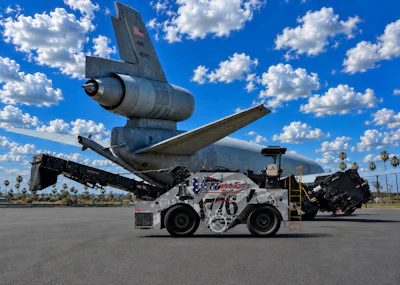
Usually, if you are hauling heavy equipment to or from a jobsite, the last thing you want is to do something that gets the attention of a law enforcement officer. However, in the case of the Vance Corporation’s custom patriotic wrap, celebrating the 250th anniversary of the founding of the United States, a couple of officers wanted to get a picture with it. It isn’t just people in uniform, though, Christian Peacock said the phone calls come in about it almost every day.
Peacock doesn’t have a formal title with the company, so much as he just goes where he is needed, and get’s done what must be done. And he also said the wrap does exactly what Vance Corporation hoped it would: earns attention. When they chose to put it on a new Astec Roadtec SB-3000 Shuttle Buggy, Peacock said the design was chosen for a specific reason in mind.
"It doesn't represent one group of people. It represents all people," he said. "And also the contributions that this country has made to make us successful. We recognize that we're only here because there were people before us that were good at what they did, and they created a market for us to be where we're at."
The company who installed the wrap is called Avi Wraps, and was completed by Mike Bailey. A few years ago, though, there was very nearly a scenario before them, which could have resulted in no wrap, no shuttle buggy, and no Vance Corporation, at all.
A Bedroom For An Office
Vance Corporation paves out of Beaumont, California. The company is employee owned, and that detail is central to this story on more than one occasion. President Derek Ritarita and Peacock have each spent more than 30 years with the company. Vice President Rob Erautt arrived later, but all three watched the business come within a few inches of closing down.
"Everybody counted us out," Peacock said. "Our office looked nothing like this. We were sharing a bedroom."
The ESOP made the slump personal, but it also made everything worth fighting for in a direct way. "Our shares were down. Everything was struggling. All that we'd worked for, for years, was disappearing, as well," Peacock said.
That same structure explains why nobody walked away. All too often, when it’s a case of outside ownership, they might look at the numbers Vance was facing, then cut and run. But these employees saw what was still possible and fought for it, because the thing they were fighting for was their own future.
"None of us wanted to give up," Ritarita said. "We saw something special there. We all got together and said, hey, there's only one place we can go, and that's up from here. We were down that far."
Renting Their Way Out
The recovery started with two decisions that cost nothing. Well, almost nothing.
The first was to stop treating other contractors as competition. Vance had good pavers, good mills, and more to the point, good people. Instead of laying crews off, the company rented them out.
"We're partners. We try to partner with everybody," Erautt said. "They're short handed with guys, so we rent guys out to them. That's where we dug our heels in at the very beginning."
The second decision was to answer the phone and treat everything coming in optimistically. "We would always answer our phones," Ritarita said. "If anybody called and needed something, they could guarantee they were going to get a hold of one of us, and we would never say no. We would just make it work."
The work was not always very glamorous, and led to Erautt calling them get-in-get-out-get-paid jobs. "We had no money in the bank, really," he said. "So, we started focusing on quick turnaround jobs, and we did a lot of them."
Their equipment fleet included an Astec Roadtec shuttle buggy, and that machine turned out to be the hinge of their whole story. Vance ran a material transfer vehicle (MTV) as far back as the 1990s before a previous president sold it. Years later, ahead of their downturn, Ritarita pushed to buy another one, and the company built a customer list around it.
"Had we not started with the shuttle buggy in previous years, if we would have waited, we would have gone out of business," Peacock said. "We just didn't have the clientele to rent it. The shuttle buggy has a really special place in our hearts for that reason."
For a couple years, while struggling at the bottom, Vance squeaked by with their work-fast strategy, but last year they blew the doors off. Now? They’re setting their sights to the horizon.
What The Machine Actually Does
Plenty of contractors have never run a MTV. Put simply, it sits between the haul truck and the paver and never lets the two touch. Trucks dump hot asphalt mix into a front hopper, a conveyor lifts the mix into a surge bin, a remixing auger turns it over, and a second conveyor feeds the paver hopper while everything keeps moving. That constant motion is the key element.
Roadtec built the first one in 1989. The SB-3000 Vance bought from Herrmann Equipment, the Astec dealer covering California and Nevada, carries 30 tons in the bin and moves up to 600 tons per hour, according to Astec's published specifications. A hopper insert can even take storage to 45 tons.
Five Reasons to Put One Into the Mix
Production climbs. Erautt credits the machine for winning work. "We're landing a lot of jobs because of the shuttle buggy," he said. "We are upping our production more than 20% because we were not worried about trucks sitting there."
The mat gets smoother. Every time a truck backs into a paver, it bumps it. Even if it seems gentle, it can leave a lasting impact on the smoothness. When you’re building roads, that’s the last thing you want.
"You get a little bump in the road," Erautt said. "It's a lot harder on the guys to get that roller mark out or get that bump out of the road." An MTV takes the truck off the paver entirely, and Vance runs the machine even on jobs that never asked for one. "Even when agencies don't require the shuttle buggy, we put our shuttle buggy on, just because we take pride in our work," Ritarita said. As more DOTs tighten smoothness bonus and penalty structures, that pride pays a dividend.
Segregation stops. Ritarita pointed at a failure some crews stop noticing. "Whenever you're running with the dumps, the paver has those hoppers that fold in, and a lot of that rock and aggregate gets stuck in the sides of it," he said. "When you fold it in on that last truck, that's all that aggregate that fell down in there. Now you've got big rock pockets."
The MTV's triple pitch auger turns the load over before it reaches the paver. Astec links segregation to cracking, raveling, stripping and rutting, all of which start with non-uniform density.
The mix stays hot. Instead of that churning shedding heat, Ritarita explained that just the opposite happens. A haul truck forms a crust on top of the load the longer it sits idle, and the paver breaks that crust into cold material that never mixes back in without some segregation issues.
"Once the shuttle buggy breaks that crust up and remixes it, it keeps it together," he said. "You're always constantly having hot asphalt on top of hot asphalt, not over the crust of it, not cold."
The truck count drops. Astec published a truck cycle example built on a 10-hour day: 2,400 tons, 20-ton trucks, a 10-mile haul, and a truck cost of $60 per hour. Without an MTV, that job needs 14 trucks at $8,400. With one, it reportedly needs only 10 trucks at $6,000, and cost per ton falls from $3.30 to $2.40. If you ran those assumptions against your own haul before quoting anybody a number, it might make just enough difference to impact your bid, and, more than likely, the bottom line.
Operating MTVs Requires Some Knowhow
The machine is easier to operate than it used to be, but finding the right person to operate it is not. This is the same issue the entire industry is facing across all experienced operator needs. What are some of the qualities a shuttle buggy operator might need, though?
"You just don't want to throw any operator on there," Erautt said. "You want an operator that doesn't mind getting his hands dirty, that knows how to wrench, listening for noises and then inspecting the machine. You want somebody that can weld [if you can find them]."
Ritarita credits the manufacturer for the rest. "Astec has made it operator friendly," he said.
The good news is that operator training runs faster than most contractors expect, and Vance starts candidates on the ground. "We started him off as a ground man, dumping into the shuttle buggy, and then hopping up and running with the operator," Erautt said. Two weeks of seat time gets a capable hand running it alone, and the apprentice Vance brought in was operating inside a month.
What Comes Next?
The obstacles now look nothing like the ones that nearly ended the company. Bid lists that used to hold 4-5 contractors now hold 13-14. California's engine tier phase outs hit a fleet of older iron hard, and Peacock puts a repower at $70,000-80,000 on a single machine. Personnel still tops the list. "Once we get guys, we keep guys," Rob said.
One of the major incentives Vance Corporation has over its competitors, in terms of recruiting and retaining their workforce, is the knowledge that every employee is also an owner. The success of the company is directly tied to their personal success in a way that non-ESOP structures can’t compare to. That’s something that they hang their comeback success on, and, also their future.