Although concrete’s reputation as a strong, durable material is certainly well-earned over many centuries, even the best-placed concrete remains vulnerable to the elements without proper protection. Exposure to water, freeze-thaw cycles, UV radiation, deicing salts, and airborne chemicals can undermine its structural integrity, accelerating deterioration and shortening service life.
As asset owners and specifiers increasingly demand longer-lasting, lower-maintenance structures and sustainable building practices, weatherproofing has become a cornerstone of modern concrete construction. Utilizing latest weatherproofing techniques, materials, and best practices should enable contractors deliver resilient, high-performing concrete structures.
Why Weatherproofing Concrete Matters
Though it appears solid and impenetrable, concrete is a porous material. Its network of capillary pores and microcracks act as conduits for water and aggressive agents to penetrate the concrete matrix. Left unchecked, this permeability leads to a cascade of durability issues: freeze-thaw cracking, corrosion of embedded reinforcement, efflorescence, chemical attack, and biological growth.
The mechanisms behind these issues are well understood. As water or other fluids infiltrate the concrete, they carry dissolved ions that can reach the steel reinforcement, depassivate its protective oxide layer, and initiate corrosion. The expansion of corrosion products exerts tensile stresses on the surrounding concrete, leading to cracking and spalling. Similarly, freeze-thaw cycles induce internal stresses as trapped water freezes and expands within the pores, eventually fracturing the material.
At the same time, asset owners and regulatory bodies increasingly expect documented proof of durability and sustainability. Tools such as Environmental Product Declarations (EPDs), embedded moisture and temperature sensors, and infrared thermography now help contractors monitor the condition of concrete in real time, verify compliance with performance specifications, and proactively address emerging vulnerabilities. These diagnostic and monitoring technologies complement material-based strategies, providing data that guides maintenance and extends service life.
Weatherproofing, therefore, is not an optional add-on but a fundamental part of sound construction practice. It is a layered, integrated approach that begins with the mix design and extends through placing, finishing, curing, detailing, and ongoing monitoring. Each of these layers addresses specific mechanisms of deterioration to maximize the resilience and longevity of the structure.
 Crystalline waterproofing admixtures react within the concrete to block water pathways and self-heal microcracks, providing long-term durability from the inside out.The Euclid Chemical Company
Integral Waterproofing: Building Protection from Within
The most effective weatherproofing practices often start at the batching plant. Integral waterproofing admixtures serve to either chemically or physically reduce permeability throughout the concrete matrix, ensuring a defense that is inherently built-in rather than merely surface-deep.
Crystalline admixtures remain at the forefront of this category. These reactive materials form insoluble, needle-like crystals within the concrete pores when exposed to moisture and calcium hydroxide, blocking pathways for water while retaining vapor permeability. Of particular value is their ability to self-seal microcracks up to 0.4 mm, which aligns with durability and sustainability goals.
Ground-penetrating radar (GPR) and embedded sensors can later help verify that such self-healing mechanisms are functioning in the field, providing asset owners with confidence in their long-term performance. Similarly, hydrophobic pore blockers — based on stearates, silanes, or siloxanes — line the internal pore structure with water-repellent compounds. This approach repels liquid water while still allowing vapor diffusion, making it suitable for exposed architectural elements.
Another highly effective internal strategy involves optimizing the mix with pozzolanic and densifying additives such as silica fume, fly ash or recycled-glass pozzolans. These supplementary cementitious materials (SCMs) refine the pore structure and reduce the permeability coefficient of hardened concrete, enhancing resistance to ingress while improving strength and durability.
Many of these newer SCMs also contribute to embodied-carbon reduction, aligning with increasingly common carbon disclosure requirements. Concrete contractors who understand how to read and apply EPDs can specify mixes that meet both durability and environmental goals.
 Penetrating concrete sealers repel water while allowing vapor to escape.The Euclid Chemical Company
Surface Treatments: Sealing the Envelope
Topical surface treatments remain indispensable, particularly for existing concrete structures or in projects where visual aesthetics are an important element of the overall design. These surface treatments generally fall into two categories: penetrating sealers and film-forming coatings.
Penetrating sealers, based on silanes, siloxanes, or lithium silicates, chemically bond within a substrate without forming a surface film. They are UV-stable, water-repellent and breathable, impeding trapped moisture and scaling. Many manufacturers now offer ultra-low-VOC formulations that meet stringent environmental standards while delivering high performance. Contractors can use digital moisture meters and surface absorption tests for adequate penetration and to assess field performance.
 Moisture vapor testing is essential to prevent coating failure, blistering, or delamination caused by trapped water beneath impermeable barriers.The Euclid Chemical Company
However, as advanced diagnostics have shown, trapped moisture beneath a non-breathable coating can lead to blistering, delamination and failure. Pre-installation moisture vapor testing and thermal imaging are now standard practices to help contractors avoid these pitfalls and deliver durable results.
More about waterproofing on ForConstructionPros.comThe Basics of Waterproofing Concrete Foundations - Adding foundation waterproofing to a concrete business can increase your profits. Waterproofing Our Concrete Infrastructure - The repair and re-waterproofing of a concrete water tank might just buy another decade or two so towns and cities can budget for the new expense. Protecting Decks From Water Damage - Whether wood, concrete, or otherwise, exterior decking is continuously exposed to the elements. It’s why the long-lasting performance that your customers expect depends on sound waterproofing practices. |
Membrane Systems: Below-Grade & High-Risk Applications
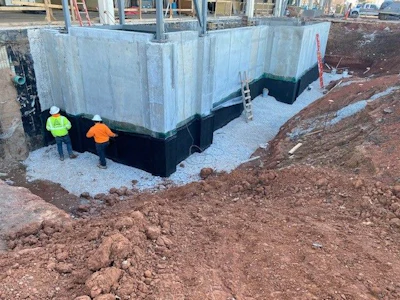
For below-grade, podium decks, and other high-risk areas subject to hydrostatic pressure, membrane waterproofing systems offer superior reliability. They are specifically designed to resist sustained water pressure and prevent infiltration even when the concrete is fully saturated, making them essential in conditions where capillary absorption and vapor diffusion alone cannot be controlled.
Sheet-applied membranes, which typically consist of rubberized asphalt bonded to HDPE or fleece-backed sheets, create a durable, flexible barrier on the concrete surface when properly installed with sealed laps and terminations. Pre-formed thickness ensures uniform performance and minimizes application variability. Quality control is often validated with electronic leak detection, which has become increasingly prevalent in critical waterproofing installations.
Liquid-applied membranes, based on polyurea, polyurethane, bituminous emulsions or cementitious chemistries, cure in place to form seamless, monolithic layers that conform to complex geometries. Hybrid polyurethane-polyurea systems offer rapid curing and superior chemical resistance, making them ideal for demanding environments such as wastewater treatment plants and parking structures.
Both approaches demand strict attention to substrate preparation, weather conditions and curing parameters to achieve optimal performance. Embedded monitoring devices and infrared surveys post-installation can help to detect voids or weaknesses early, reducing liability and maintenance costs.
Drainage, Joints & Details: The Often-Overlooked Weak Points
Even the most sophisticated waterproofing system can still fail if poor site drainage channels water toward the concrete structure. Grading the site to direct runoff, incorporating vapor barriers under slabs and installing sub-slab drainage systems remain foundational strategies to prevent this from occurring. Remote monitoring sensors are now being deployed in some high-value installations to track sub-slab humidity and detect groundwater intrusion before visible damage forms.
Cracks and joints require equally meticulous attention. As inevitable points of movement and stress, they demand specialized treatment during installation and maintenance. High-performance joint sealants, based on urethanes, silicones or polysulfides, must accommodate movement while maintaining adhesion. When water ingress through cracks does occur, polyurethane injection foams can be used for flexible, watertight repairs or epoxy injection resins for structural restoration.
The majority of water intrusion in concrete structures occurs at joints, penetrations and detailing errors. By combining traditional sealant techniques with modern tools such as GPR and moisture-sensing probes, contractors can locate and address weaknesses more efficiently.
Prevention is far more effective — and economical — than repair.
The Critical Role of Proper Curing
Proper curing is one of the most critical — yet often overlooked — aspects of concrete weatherproofing. Without adequate moisture and temperature during early hydration, concrete becomes more porous, weaker and prone to shrinkage cracking, all of which compromise durability.
Hydration forms calcium silicate hydrate (C-S-H), the dense gel that gives concrete its strength. If moisture evaporates too quickly, especially in hot, dry or windy conditions, hydration at the surface stops prematurely, leaving it porous and vulnerable. Poorly cured concrete can be up to 50% more permeable than properly cured material, greatly reducing its resistance to water and chemicals.
There are several effective techniques that can be used by concrete contractors to retain moisture and protect curing concrete. Wet curing with sprinkling, ponding or saturated burlap maintains full hydration but is labor-intensive. Curing compounds, which are sprayed on the surface, form a thin film to slow evaporation and are often compatible with decorative finishes. Evaporation retarders, which are applied during finishing, help prevent moisture loss in hot or windy weather, while sheets of polyethylene or geotextile trap moisture and shield the surface from drying conditions.
 Applying curing compounds helps new concrete retain moisture, reduce permeability, and prevent shrinkage cracking.The Euclid Chemical Company
For best results, curing should begin as soon as the surface can resist damage and continue for at least seven days—and sometimes even longer when SCMs are used. In cold weather conditions, maintaining adequate temperature prevents freezing before the structure develops. Increasingly, concrete contractors are using embedded sensors to monitor internal humidity and temperature in real time, ensuring curing meets specifications and optimizing duration based on actual conditions.
Building Concrete Structures with Resilience in Mind
Beyond merely avoiding unsightly stains or surface deterioration, the practice of weatherproofing concrete is about ensuring structural resilience, meeting sustainability objectives and delivering lasting value to asset owners. As environmental pressures intensify and performance expectations rise, it’s crucial to take a layered, integrated approach to weatherproofing and embrace emerging tools.
By combining integral admixtures, surface sealers, membranes, proper drainage and detailing, and meticulous curing, contractors can create robust systems tailored to each project’s specific demands. Staying on top of advanced diagnostics, monitoring technologies and evolving specifications further strengthens the ability to deliver high-performing, durable and sustainable structures.
For concrete contractors, every single pour represents another opportunity to build not just for today, but for the decades to come. And when it comes to weatherproofing concrete, the old adage certainly holds true: prevention is far more effective — and economical — than repair.