Construction sites hum with activity as cranes lift material and concrete trucks rumble through with drums turning. A scene repeated millions of times a day, across the globe, to create our roads and homes. Despite the constant activity, everything being done onsite right now is causing an uncomfortable reality. What will hold our civilization together is currently adding to its destruction.
With the vast majority of concrete utilized, around 70 percent of all construction materials, the carbon dioxide (CO2) footprint produced by concrete is so large that it would rank 3rd in global CO2 emissions, behind China and the U.S, as a country. The cement and steel manufacturing industries contribute about 8 percent each of the global CO2 emissions. Combined, these two segments produce an incredible amount of emissions compared to other sectors of the economy. Every construction site is now challenged with the same question: "How do we build while continuing to destroy?"
There are a number of solutions from laboratories, start-up companies, and innovative construction companies that represent what industry analysts are labeling as the greatest shift in building materials since the development of the Roman Empire's concrete technology two thousand years ago.
The Concrete Problem
The primary ingredient of concrete — cement — is a key component in determining the environmental impact of concrete and how it will affect climate change. The production of portland cement involves the chemical processing of limestone and clay through calcination. Calcining limestone and clay requires heating up to 1,450° C and then cooling down again. This process produces very large amounts of CO2 into the atmosphere. The second method of CO2 production occurs from the chemical process of fully converting limestone into portland cement.
Because portland cement production is, by nature, a very difficult area in which to reduce carbon dioxide emissions, the cement industry has many issues in transitioning to renewable energy sources for the heat needed to produce cement.
Using alternative fuels will not solely resolve CO2 emissions produced during the calcining process. At the same time, the construction industry is at a crossroads; the world is experiencing unprecedented growth in infrastructure development due in large part to urbanization occurring in developing countries. By 2050, it is estimated by the United Nations that nearly 2.5 billion people will move to urban centers, which will create a demand for construction similar to the amount of construction completed each month for 30 years, or basically a new New York City every month. We now need to build more concrete than we have ever needed to produce before.
The ongoing challenge of this issue has produced many new inventions. Some scientists are looking back into history to recover old practices. Consider, Roman concrete used to last for over 2,000 years but modern concrete can only last about 20 to 30 years before disintegrating. While Romans used volcanic ash, modern scientists have created their version using waste materials such as fly ash (a by-product of burning coal) or slag (a by-product from manufacturing steel). These alternative cement materials may replace up to 70 percent of portland cement and dramatically reduce greenhouse gas emissions, as well as improving durability.
Others are exploring completely different pathways. One example is the process known as carbon-cured concrete. Carbon is injected into the wet concrete mix and undergoes a chemical reaction with the cement during the curing phase of the project — permanently trapping carbon in the concrete.
Mass timber is experiencing an unusual revival as a viable construction material for high-rise buildings. Previously, steel and concrete were the two standard materials used in tall buildings. Cross-laminated timber plates consist of multiple sheets of engineered wood glued together at right angles (perpendicularly) to each other, allowing cross-laminated timber panels to replace steel and concrete in the construction of buildings up to twenty stories tall. Trees capture carbon from the environment as they grow, which means that wooden constructions have the capacity to store CO2 in the fiber, capturing carbon from the atmosphere.
Mycelium is a type of fungal root that can be formed into insulation panels or structural blocks for construction, by growing them from mycelium.
Hempcrete, made from the hemp stalk and the lime of the plant, offers superior insulation and has the ability to absorb more carbon while the plant is growing, than what is emitted during the manufacturing of the hempcrete. While these types of bio-based materials are not yet mainstream construction materials, they represent a path forward to using the resources of nature to create innovative construction materials that we may not have previously considered.
Decarbonizing is also an issue for the steel industry. For decades steel has been manufactured using coal-fired blast furnaces to convert iron ore into liquid iron and creates CO2 as a byproduct of this process. However, plants are producing "green" steel by switching from coal to using hydrogen in the conversion process and are starting to produce green steel on a large scale. SSAB manufactured the first CO2-free steel (green steel) and delivered the first green steel to Volvo in early 2021. The company used renewable sources to produce hydrogen instead of coal during the steel-making process. Green hydrogen has been costly to manufacture; however, with the decreasing cost of renewable power, it is expected over the next ten years that the cost of manufacturing green hydrogen will decrease and green steel will be able to be manufactured at a cost comparable to producing conventional steel by 2030 in geographies that have abundant renewable electricity generation sources.
Electric arc furnaces (EAF) that are powered by renewable electric sources provide an additional method of producing steel. EAFs use electricity to melt recycled steel scrap rather than coal as the heat source. As steel is 100 percent recyclable without detriment to the material's quality, expanding the infrastructure for steel recycling could substantially reduce the need to produce virgin steel and subsequently, the associated emissions.
Formwork & Scaffolding
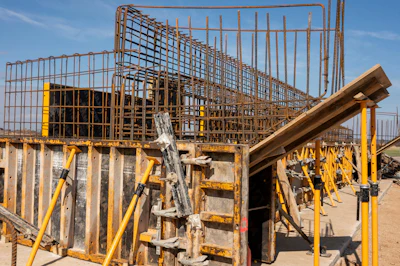
It is noteworthy that even temporary elements of construction are undergoing a sustainability transformation. Conventional temporary structures such as formwork and scaffolding consume a great deal of materials and energy. New types of modular temporary systems that are made of recycled materials and can be reused repeatedly reduce the waste generated from this type of construction. Companies are also opting to rent rather than sell their temporary construction equipment, resulting in greater incentives to build durable products that can be reused multiple times.
Consider how disposable temporary formwork is discarded after being utilized only one time. The development of reusable forms and biodegradable forms made from agricultural waste could create less waste and might decrease greenhouse gas emissions. Although designed for temporary use, these systems support the continued reduction of the overall carbon emissions from construction and building operations.
Technology won’t help us win this battle alone. Policies are helping to encourage more sustainable technologies and forms of construction through market incentives. For example, the EU has recently implemented a carbon border adjustment mechanism to penalize high-emissions materials by making them more expensive. On another front, California has recently begun requiring Environmental Product Declarations (EPDs) for all products being used in public works projects. This gives all consumers access to information on the carbon content of each product on the market and creates a monetary reward for low-carbon alternatives.
Building codes are changing as well. Many jurisdictions also require that an assessment of embodied carbon be performed on all new construction. By forcing architects and developers to consider long-term emissions in addition to operational energy consumption when creating new buildings, these changes are beginning to change the conversation around design.
Building Tomorrow
The revolution of low-carbon materials will not be without its challenges. Developers who are sensitive to price may be wary of these new low-carbon products that are priced higher than conventional products at the outset. In addition, supply chain relationships that have developed over many years using conventional materials will take time to change, and architects and engineers lack familiarity with the new low-carbon materials; therefore, they are hesitant to use them.
At the same time, there is growing momentum towards the use of low-carbon materials. Microsoft's and Amazon's commitment to using low-carbon concrete in their buildings, as well as the green building procurement policies adopted by cities such as Vancouver and Oslo, are examples of this trend. The continued success of projects using low-carbon construction materials may very well begin to erode the skepticism of the construction industry.
The urgency to reduce carbon emissions associated with the construction industry is not only an issue of protecting the environment but also of creating cities that can expand, grow, and flourish without destroying themselves in the process. As innovation continues and costs decrease over time, the reluctance of the construction industry to change will eventually be replaced by permanent conversions. Ultimately, the concrete jungle may once again have the opportunity to become a more comfortable place to live and work.