Some paving awards celebrate scale, while others celebrate difficulty. The Paving: Non-Parking Lot Award exists to recognize two types of projects:
- Roadway jobs that can push a team to its limits, and shows them rising to meat the challenges faced by traffic and working with a city.
- Less common projects that stretch the definition of where asphalt belongs and what it can solve. This year’s winning project most certainly fell into the latter category, paving inside the walls of a former industrial facility where most contractors saw nothing but problems.
But Bob Kordus saw an opportunity.
If you don't know who Bob is, then let this be your introduction, but make sure you find him at the next PAVE/X and spend some time letting him share his wealth of knowledge and experience.
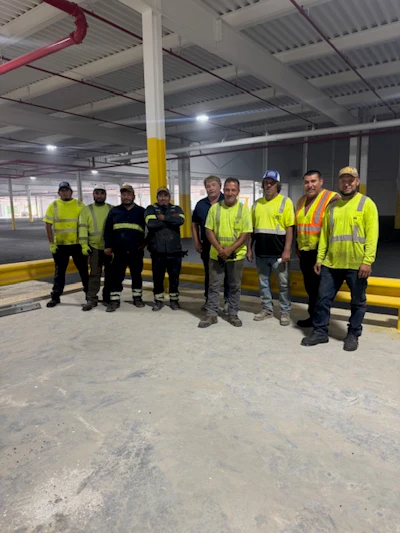
Kordus, owner of Asphalt Contractors Inc., has been a fixture in the blacktop industry for nearly five decades. He has paved in places most contractors never will, across more states than many companies ever touch, and at a scale that reflects both ambition and confidence. That confidence was on full display in Bristol, Tennessee, inside a former Exide Battery factory that had been left to deteriorate for years.
A Floor Most Contractors Walked Away From
When Asphalt Contractors Inc. was first asked to look at the project, the scope seemed straightforward on paper but overwhelming in reality.
The building’s original concrete floor had sustained decades of abuse. Failed joints. Thousands of divots and potholes. Steel posts cut off flush with the surface. Elevation changes from additions and remodels layered over one another. Years of dust and dirt ground into the slab.
The building’s owner initially planned to epoxy the floor, and multiple contractors quoted partial repairs followed by epoxy coatings. The price tags came back at roughly ~$2.2 million for incomplete coverage, with warnings that large sections of concrete would still need to be removed and replaced.
Kordus was asked to quote the epoxy work as well. He did. And like the others, his proposal only covered part of the building due to the extent of the damage. Then he had a radically different idea.
“I had an idea,” Kordus explained humbly. “Why don’t I pave the most deteriorated areas in the floor with asphalt.”
Paving indoors was not new to him. Over the course of nearly 50 years, Kordus had paved inside agricultural pole buildings, airport hangars, and industrial structures. Just not one this large. At first, he proposed a hybrid solution: paving the worst areas and epoxying the rest. When the owner saw the cost comparison, the question came back quickly.
Could the entire interior be paved?
“My response was, ‘Why not!’” Kordus said.
That answer was not just a casual optimism he was offering to a customer desperate for a solution. It was backed by experience, planning, and a company culture built around solving problems others avoid.
An Asphalt Solution That Changed The Math
By shifting the solution from epoxy to asphalt, the economics of the project changed dramatically for the client. The owner was now able to pave the entire interior of the building and add some exterior paving as well, all for less than half the cost of the original epoxy proposals. More importantly, the finished surface met the building’s intended future use as a warehousing facility.
Asphalt Contractors Inc. developed a detailed scope of work and plan of action. The interior floors were swept, base patched, and wedged as needed. A tack coat was applied, and asphalt paving followed across the massive footprint.
Material was supplied by JD Watson & Assoc., with owner Joey Watson providing not just mix, but tack coat, and trucking support.
“The mix was right on,” Kordus said. “It was actually a half inch surface mix with somewhat reduced fines.”
That mix design would prove critical, because the scale of the job was only part of the challenge. The logistics were where this project truly separated itself.
Over 2,000 tons of asphalt were placed inside a building in just four days, with the entire project completed in one week, from October 6 through October 10, 2025.
Obviously, ventilation was a primary concern when you imagine paving asphalt in an inclosed space. While many people claim to love the smell of asphalt, it is not safe to be hot-boxing those fumes. So, Kordus designed a cross-flow exhaust system using gasoline-powered fans, as well as massive barn fans, to maintain air quality throughout the operation.
The next thing you probably would consider a problem is how to actually bring the asphalt into the space. Truck access presented another major constraint, as only one area of the building had sufficient height for dump trucks to unload indoors. So while they used that one safe spot to bring it inside, the asphalt then had to be transported to the paver using skid loaders.
“Originally we were going to use [just] two skid loaders to feed the paver,” Kordus said. “But the flow was not fast enough.”
The solution was simple, but not obvious.
“We eventually added more loaders until we had a total of four feeding the paver,” he said. “This created a steady paving rate.”
Once that balance was achieved, trucking, paving, and compaction moved in sync.
Compaction, Mix, And Finish
Paving asphalt over concrete inside a building introduces a different set of performance considerations. The mix design, rolling pattern, and timing all had to work together. Because of the reduced fines in the mix and the rigid concrete base below, the crew used a knock-down roller immediately behind the paver, achieving over 90 percent compaction early in the process.
“This left the finish roller time to get a perfect finish roll on the mat,” Kordus said. “This will also result in less marks in the future.”
Where the main paver could not reach, a path paver was deployed to work around columns, floor drains, and tight areas. The result was a surface Kordus described without hesitation.
“The floor is flat as a pool table and has an extremely smooth ride,” he said.
When asked whether this was the first time he had paved asphalt indoors, Kordus laughed.
“If you want me to pave on top of your desk, I’ll pave on top of your desk,” he recalled, repeating advice from one of his early mentors. “The customer always gets what he wants.”
That philosophy has guided Asphalt Contractors Inc. since its earliest days to the continued success it has today. Many years ago, when the company was just getting started, Kordus asked his brother Peter whether they could take on certain challenging tasks for a large client.
“Peter responded saying, ‘We can do any ****** you want, just bid on it and we will get it done,’” Kordus said.
Today, Asphalt Contractors Inc. self-performs all of its work. The company operates in thirty-eight states, owns two asphalt plants, two gravel pits, five aggregate recycling yards, and employs more than one hundred fifty people.
Its services extend beyond asphalt. At the time of this writing, the company is assisting in the construction of an AI data center in Indiana, a project with no asphalt component at all.
“That really pushes the limits,” Kordus said.
But risk, in this context, is not recklessness. It is confidence built on repetition, systems, and a team that knows how to execute.
“Not too bad for a company started by two guys with a pickup truck, two drums of sealer, and a home-made blower,” Kordus said.
Why This Project Won
The Bristol project earned the PAVING: Non-Parking Lot Award not simply because it was unusual, but because it was executed with precision, discipline, and creativity.
By rethinking logistics, ventilation, and material flow, his crew placed thousands of tons indoors safely and efficiently. By controlling mix design and compaction strategy, they produced a finished surface that met the owner’s long-term needs.
It is the kind of project that could only be delivered by a contractor who has spent decades learning where the limits are, and how to push past them. In a building where most saw a problem, Bob Kordus and Asphalt Contractors Inc. saw a blank canvas and answered the only question that mattered.
Why not?