*This article is sponsored by BKT USA, Inc.
One of the most important factors to consider when selecting a tire is the type of mining and the specific terrain conditions. Mining environments vary widely across the globe: these include hard- or soft-rock mining, surface mining, underground mining, and many others. Let’s look at them one by one.
In hard rock mining, haulage roads are often covered with hard, sharp rocks, and these conditions pose a high risk of frequent tire damage, including cuts, punctures, and excessive wear.
Soft rock mining, commonly associated with coal mines, presents different challenges to tires, causing them to wear out more quickly. Compared to hard rock surfaces, soft rock mining environments generally have a lower rate of damage due to the specific type of surface.
Loose soil, grave, and loose stones are typical of surface mining, requiring tires with good traction and resistance to uneven wear. Finally, underground mining is typically characterized by hard-rock underfoot terrain and narrow haulage roads, significantly increasing the risk of tire sidewall damage.
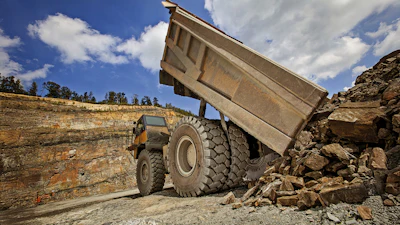
After a detailed analysis of mining sites and their specific needs, BKT Tires has developed and engineered a range of tread patterns tailored to address different mining conditions, where multiple types of equipment operate with unique operational requirements. In this article, we will focus on articulated dump trucks (ADTs) and haulage trucks, commonly referred to as rigid dump trucks, and the tire solutions designed to support their demanding operating conditions.
Based on crucial factors such as machine load-carrying capacity, operating speed, haulage road conditions, distances, site requirements, and TKPH/TMPH values, BKT Tires proposes a wide range of tire solutions with specific tread codes, such as E-3 and E-4. Within these codes, BKT Tires offers tailored products to meet different mining applications and operating conditions.
For mine sites operating ADTs, BKT typically recommends an E-3 tread depth, selected based on the machine’s load-carrying capacity and TMPH requirements. BKT’s E-3 portfolio includes several proven patterns, such as EARTHMAX SR 30, EARTHMAX SR 31, and EARTHMAX SR 35. In certain cases, EARTHMAX SR 41 (E-4 tread depth) may be recommended based on detailed site studies.
For mine sites operating haulage trucks, also known as rigid dump trucks, BKT generally recommends an E‑4 tread depth, determined by machine load‑carrying capacity and TMPH considerations. The E‑4 range includes multiple tread patterns, such as EARTHMAX SR 45, EARTHMAX SR 45 PLUS, EARTHMAX SR 45 M, EARTHMAX SR 46, EARTHMAX SR 47, EARTHMAX SR 47 TP, and EARTHMAX SR 48. In the Giant ROTR category, the most popular solutions — based on extensive site studies — are EARTHMAX SR 468 and EARTHMAX SR 454.
The selection of the tire category is also influenced by tread compound usage, a critical consideration in the OTR mining industry. Compound selection plays a significant role in determining tire performance, durability, and operating life under specific site conditions. Based on the application, haulage road conditions, machine speed, and haulage cycle time, BKT Tires offers a wide range of tread compounds within a single tread design, including cut-resistant, standard, and heat-resistant compounds, to ensure optimal performance across varying mining conditions.
Selecting or replacing tires without a proper understanding of the mine site conditions can lead to increased downtime, safety risks, poor tire performance, and premature tire failure. Therefore, it is crucial to thoroughly study and understand the mine site and its specific application requirements. For optimal tire selection and performance, it is highly recommended to consult a BKT expert for technical guidance and expertise.