Intelligent compaction technology provides real-time digital data that proves asphalt quality to inspectors and clients, eliminating costly rework and helping contractors win more contracts through data-backed quality assurance.
- Proactive vs. reactive: IC systems monitor compaction in real-time instead of waiting for post-cooling core samples that may reveal costly density failures.
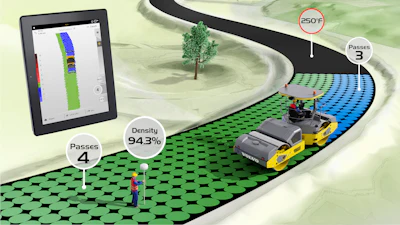
- Three critical data points: Pass mapping shows roller coverage, temperature mapping confirms optimal rolling windows, and density estimates verify target compaction levels are met.
- Competitive advantage: Contractors using IC data-backed quality control win more commercial and government bids by providing digital proof of specification compliance.
- Risk protection: Digital archives of compaction data protect businesses against future warranty claims and premature pavement failures years after project completion.
- Real-world results: West Contracting uses IC technology to consistently meet MoDOT's 92% minimum compaction density requirement while eliminating over-compaction waste.
In paving work, you may view intelligent compaction (IC) strictly through an internal operational lens, focusing on how much fuel it saves, how many passes it eliminates, and how it speeds up project timelines.
And while those are significant benefits of the technology, IC offers another key advantage that may sometimes be overlooked: The digital data trail it provides. Advanced IC technology helps you achieve high-quality work, but also provides the data to prove the integrity of that work to inspectors, win client trust and build your reputation.
Quality Requirements And Challenges
Inspection requirements for road projects are incredibly strict since they’re entirely dependent on sequence. If a single layer or process is botched, the final project may fail inspection, or the structural integrity of the pavement could be compromised.
Standard inspection and quality control requirements on these projects span across all major phases of the work, and the process measures factors such as temperature thresholds, surface consistency, and under-compaction or over-compaction.
With asphalt paving, for example, traditional quality control methods tend to be reactive. Core samples or nuclear gauge tests are typically performed well after the asphalt has cooled below working limits. If the tests reveal low density, you can face severe financial penalties or worse, the expense of milling out and replacing the asphalt mat.
Another key challenge is the sample size. Core samples only represent a tiny fraction of the total pavement surface area. You might get passing results on physical core samples but be missing localized issues across the rest of the untested mat.
Intelligent compaction technology is a proactive quality-control measure that helps address many of the challenges involved with the process.
 Volvo CE
Quality-Control Benefits Of Intelligent Compaction
IC systems eliminate the guesswork and the time lag involved with traditional quality control measures, allowing operators to monitor their work in real-time from the platform or cab. It’s a transformative technology for asphalt compaction, so much so that a growing number of states include IC specs or strongly recommend the use of this technology on highway projects.
IC data can track:
- Pass mapping, giving operators a clear on-screen view of the roller’s coverage of the asphalt. The system can highlight stop points and overlaps so adjustments can be made quickly and efficiently without missing a spot. This helps eliminate under- and over-compaction.
- Temperature mapping, documenting that the asphalt was rolled within the critical, optimal temperature window before cooling. A color-coded map of surface temperatures and the ability to set the maximum and minimum range enables operators to easily avoid rolling with a mix temperature that is too hot or too cold.
In addition to pass and temperature mapping capabilities, which most IC systems offer, Volvo’s Compact Assist with Density Direct system also provides density estimates to operators in real time, rather than intelligent compaction measurement values (ICMV), which are essentially a measurement of stiffness. This provides greater accuracy and reporting opportunities through the addition of a high-accuracy GPS antenna, recorded and saved job data, automatic job report creation with USB and over-the-air downloads.
Paving contractors who use Compact Assist with Density Direct know exactly when they hit target densities. For discussions with clients, a comprehensive digital map of the finished mat can be like a receipt for quality to prove the job was completed to the exact specifications.
These capabilities can also offer ROI benefits down the road. When you’re competing for commercial work or government bids, contractors who actively advertise using data-backed quality control can win more work. And maintaining a digital archive of every project’s compaction data helps protect your business against future warranty claims or premature pavement failures years down the road.
 Volvo CE
Real-World Validation
So how does this all come to life on jobsites?
West Contracting has embraced advanced IC technology to track density values in real time and eliminate any destructive over-compaction. The asphalt contractor has four asphalt plants, nearly 200 employees and almost 400 pieces of heavy machinery, handling complex highway projects in the St. Louis metro region. The Missouri Department of Transportation (MoDOT) mandates the use of IC on highway projects, including infrared thermal profiling. These “IC-IR” jobs require hitting specific targets on thickness laid, density of the mix and smoothness.
To ensure they are properly hitting those targets, the West Contracting crew relies on Volvo’s Compact Assist with Density Direct system. Their asphalt rollers include technology that virtually connects them and provides data to ensure that teams achieve proper asphalt compaction. With the help of GPS, cameras and sensors, operators can see on a screen where they have been, the temperature of the mix and its current density. A color-coded pass map makes it easy to see what they need to do and when to move on so as not to over-compact the material.
The technology helps West Contracting achieve high-quality work every single shift and provide data as proof, drastically reducing the risk of costly rework or structural penalties. The visualization gives West confidence that they can meet MoDOT’s minimum compaction density requirement of 92%.
A Data-Driven Competitive Edge
The fuel and time savings offered by advanced IC systems help get you through the current job profitably. But the data provided by these systems can you secure the next 10 jobs and ensure you deliver quality results. The data becomes your quality assurance shield, providing proof to inspectors and clients that all requirements have been met.