The House Education and the Workforce Committee voted 18 to 15 on July 21 to advance H.R. 6213, the Heat Workforce Standards Act of 2025. Every Republican on the panel voted yes. Every Democrat voted no. The bill now waits on a floor vote in a chamber where 63 Republicans have signed on as cosponsors and no Democrat has.
The legislation does one thing. It forbids the Secretary of Labor from finalizing, implementing, or enforcing the heat injury and illness prevention standard OSHA proposed on August 30, 2024, along with any “substantially similar” rule. It carries no sunset date and no mechanism for Congress to revisit the question if heat related injury or death continue to rise. It does not amend the standard or send OSHA back to rewrite it. It functionally closes the door and takes the handle off.
Of course, road crews have a lot more riding on this development than others.
The Safety Rule They Call Red Tape
OSHA's proposal sets two thresholds. At a heat index of 80 degrees, employers would supply a quart of cool drinking water per worker per hour, shaded or air-conditioned break areas, paid rest breaks as needed, and an acclimatization plan for new and returning workers. At 90 degrees, employers would add a paid 15-minute break every two hours, a buddy system or supervisor observation, and a pre-shift hazard alert.
Water, shade, and a break. A few small changes intended to protect our vulnerable workforce in the field. That’s it.
Rep. Mark Messmer (R-Indiana), who introduced the bill in November 2025, describes that package differently. After the markup he called the vote, “An important step toward rolling back more of the unnecessary Biden-era regulations,” and said he intends to keep, “reducing trivial red tape which is depressing the success of our great nation.”
Forty-eight workers died from environmental heat exposure in 2024, according to National Safety Council analysis of federal fatality data. CPWR reports that half of the heat-related fatal injuries that year happened to construction workers. Researchers have also found that three out of four occupational heat deaths occur inside a worker's first week on the job, which is the exact gap the acclimatization requirement is meant to address.
Blacktop Math
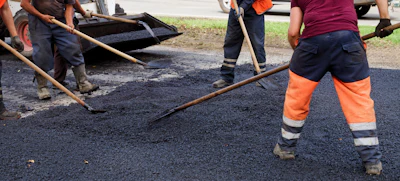
I covered this topic before. Last September I reported on how Texas, Florida, and Georgia used state preemption laws to strip local municipal governments of the power to require water and shade breaks for outdoor workers. Field research cited in that piece found asphalt crews experience felt temperatures 13-to-29 degrees above ambient air, driven by radiant heat coming off the mat.
For anyone who's been out with an asphalt road crew, those numbers are anything but abstract. Running a finish roller on a 92-degree day, I measured 102-to-106 degrees in my own working position. Things can vary wildly. An 80-degree heat index at the truck can be a very different afternoon running the screw.
ARTBA Asked For A Standard, Not A Ban
Here is the part that should get the attention of anyone who paves in the field for a living.
The American Road & Transportation Builders Association, which represents more than 8,000 members, formally opposed OSHA's proposal. I covered that filing in November. ARTBA objected to the prescriptive structure, to the documentation load of logging individual water consumption and break times, and to the crew costs of mandated break intervals.
But ARTBA never asked Congress to eliminate federal heat rulemaking entirely. It asked OSHA for a performance-based standard modeled on the silica rule, scaled to job type, daily hazard analysis, and task-specific exertion levels.
H.R. 6213 forecloses that outcome. The “substantially similar” language would block a performance-based heat standard as thoroughly as a prescriptive one. The Senate's companion legislation, introduced by Sen. Bill Cassidy (R-Louisiana) as S.4427 on April 29 with 11 Republican cosponsors and no Democrats, mirrors the House's intent. Cassidy chairs the Health, Education, Labor and Pensions Committee.
The National Federation of Independent Business (NFIB) led 50 trade associations in a letter to Cassidy and Messmer dated the same day Cassidy filed the Senate bill. After the House markup, NFIB federal government relations director Dylan Rosnick said the act, “Would protect small employers from being disproportionately impacted by particularly burdensome and costly new one-size-fits-all mandates.”
An Enforcement Vacuum Is Already Here
OSHA's National Emphasis Program on heat expired April 8, 2026, and the agency did not renew it. That program drove roughly seven thousand heat inspections between April 2022 and December 2024, compared with about 200 per year before it existed. Its lapse leaves the General Duty Clause as the only federal consideration, and that clause forces OSHA to build a recognized-hazard case one citation at a time.
The standard itself has sat untouched since the post-hearing comment period closed October 30, 2025, and the Trump Administration has announced no target date for a final rule.
The bill in question still needs a floor vote, and the Senate has shown no urgency, not even when it comes to the Build America 250 Act's surface transportation reauthorization. But the committee tally gives contractors a strong indication of what this Administration and its allies in Congress intend.
As crews keep paving through the high heat days of August, they do so with the knowledge the law creeping closer to passage isn't designed to protect them, but to protect their employer's bottom-line. The open question in Washington right now is whether or not they'll pass surface transportation funding before or after they make the job less safe for its vulnerable workforce.