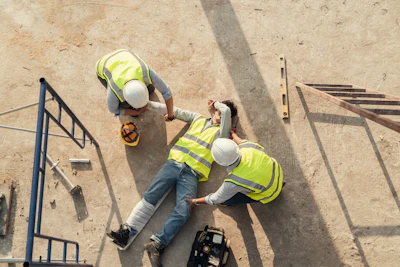
Anyone who's walked jobsites knows how thin the margin is. A spotter retreats half a second late. An operator loses sight of a ground worker behind a haul truck. Someone steps across the haul road at the wrong moment. When the traffic control plan holds and every camera and backup alarm works exactly as designed, nothing happens. But near-miss data doesn't favor the operator, and anyone who has spent real time around heavy equipment knows how close "nothing happens" is to something happening.
The OSHA numbers back this up. Struck-by incidents are one of construction's "Fatal Four" hazards, and heavy equipment — trucks, cranes, loaders — accounts for roughly 75% of struck-by construction fatalities. That risk shows wherever people and equipment share the same ground, and it's rarely the exotic failure that gets someone hurt. It's the routine stuff: backing operations, hauling, positioning a load.
Automation will not eliminate every jobsite risk, and I'm not going to claim it does. But it takes a real bite out of struck-by exposure specifically. The fair and honest question, whether you're in the construction industry or just watching it from outside, is whether the technology actually lowers risk or just moves it somewhere else on the site.
The Proximity Hazards in Heavy Construction
Most struck-by accidents on civil and heavy construction sites trace back to the same root cause: a person and moving equipment occupy the same space, and communication or visibility breaks down at the wrong moment. A blind spot. A missed radio call. A worker who's grown too comfortable in a familiar environment and steps where they shouldn't. The traditional answer has been passive proximity detection of flashing lights, sirens, backup alarms. Those tools matter and are not to be dismissed. But they're reactive by design. They only fire once a hazard already exists or an exclusion zone has been breached, and at that point the decision lands on a fatigued operator or a ground worker who never saw it coming.
None of this is because construction teams aren't trying. The industry has made real progress through better training, proximity detection and tighter internal traffic control plans. But there's a ceiling on how much risk you can train away as long as people are working near running equipment for hours at a time. Active fleet orchestration changes the equation. Instead of a simple alert, you get predictive logic and real-time decision-making across the whole fleet. A standard proximity alarm fires at a fixed distance, full stop. An orchestration platform tracks the intended path of every machine on the site at once, in relation to every worker in the area, and adjusts before a conflict ever develops.
To be clear, an active fleet doesn't retire spotters, exclusion zones or your traffic control plan. Those still matter, especially during the mixed-fleet phase where autonomous and operator-driven equipment share the same ground. But the core principle doesn't change. The safest way to handle a struck-by hazard is to make sure it never has a chance to form - - - positive separation between people and equipment, maintained continuously, not just when someone remembers to check.
Optimizing Workforce Efficiency Amid Labor Shortages
The safety case for fleet orchestration would matter on its own. But it lands at a moment when the industry is dealing with a labor shortage that isn't going away. That pressure hits smaller and mid-sized contractors hardest. They feel the shortage first and rarely have the flexibility to simply hire their way out of it. Automated fleets let existing crews cover more ground without putting more people in harm's way.
Active sites with automation change the staffing picture more than it shrinks it. Usually, the headcount doesn't drop. What changes is where people stand. Instead of multiple operators working in the field for hours at a stretch, one operator can monitor a fleet of coordinated vehicles from a safe location. That's work that used to require several people in proximity to heavy machinery, running fatigued shifts with real exposure the entire time. The balance of personnel transitions to other value-added command center tasks.
Operational Requirements for Autonomous Deployment
Successful deployment starts with mapping the site itself, not the vehicle. Every jobsite has its own terrain, traffic patterns and site-specific hazards. A vehicle only runs reliably without a driver once those details are recorded, planned for, and built into the system it's operating on. Keep that feedback loop running between the physical site and its digital model, and contractors get a level of precision and safety manual operations can't touch.
Continuous environmental monitoring matters just as much, especially with weather you can't control. Heavy rain, dense fog and blowing dust all degrade sensor performance. The system must process those shifts in real time and adjust the fleet's operating parameters accordingly, not just log the problem. If visibility drops below a set threshold, it needs to cut vehicle speeds or reroute the haul road on its own, without waiting for someone to call it in.
A system that only works in good conditions isn't a system to put your name on. Meeting that bar is hard, but it's the step the industry must clear to move past pilot projects and into safe, large-scale deployment. There's no shortcut around careful jobsite preparation and a system built to hold up under real conditions.
The Industry-Wide Imperative to Evolve
Said plainly, automated fleets alone won't solve construction's safety and labor problems. But struck-by incidents remain stubbornly common, the labor pool isn't growing and the tools for addressing both problems together are more capable today than they were even five years ago.
Getting to widespread adoption means shifting how this industry thinks about itself. For decades, we've equated physical endurance and the ability to grind through harsh conditions with skill and dedication. That mindset respectfully built this industry, but it's also part of what makes it harder to recruit the next generation. Contractors who move toward tech-forward, safety-conscious operations are telling their people something real about how much their well-being matters. That shift redefines the operator's role from physical strain to technical expertise and remote fleet management. And that's a role a lot more people want to sign up for.
Contractors are turning to automation because traditional safety measures alone haven't moved the struck-by numbers enough. Getting people out of the line of fire isn't a nice-to-have. It's a fundamental change in how this industry defines safety and professionalism.