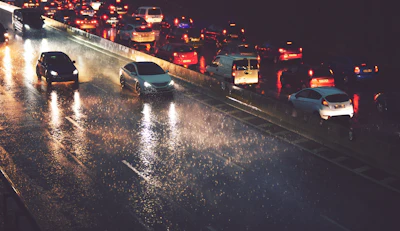
A University of Houston study using artificial intelligence to analyze crash narratives found that pavement friction and drainage—not smoothness—are the primary factors in wet-weather crashes, suggesting preservation programs should prioritize friction treatments and curve improvements over traditional smoothness-focused repairs to maximize safety per dollar spent.
- Friction matters most: Nearly two-thirds of pavement-related crashes involved wet-pavement or hydroplaning, while potholes and rough pavement accounted for under 2 percent of crashes.
- AI methodology: Researchers used GPT-4 to analyze 24,000 police crash narratives and link them to 180,000 road segments, matching human judgment on crash mechanisms with measured accuracy.
- Repeat problem segments: Hydroplaning crashes clustered in specific locations with recurring water retention, meaning targeted treatments on these segments prevent the most crashes per dollar.
- Treatment priorities: High-friction surface treatments, micro-surfacing, and chip seals deliver better safety returns than mill-and-fill smoothing approaches for wet-weather crash reduction.
- Convergence with practice: The study's findings align with what transportation agencies are already moving toward, strengthening confidence in friction-first preservation strategies.
Every preservation program is an exercise in roadway triage. When it comes to maintaining public infrastructure, there is never enough tax-money to treat every mile that needs it, so the list gets ranked. These rankings usually get sorted by condition score, ride quality, and how long it has been since the last treatment. Safety sits somewhere in the mix, but rarely drives the ranking because the data tying a specific pavement condition to a specific crash has never been easy to come by.
New research suggests safety should drive more of that ranking than it does, and points to a specific place to put the money.
A team led by the University of Houston, in a study funded by the Texas Department of Transportation (TxDot) and published originally in the journal Accident Analysis and Prevention, used artificial intelligence to connect two datasets that normally never meet: roughly 24,000 police crash narratives and a pavement management database of about 180,000 road-segment records.
The question it set out to answer is: when pavement is a factor in a crash, which pavement property actually matters?
The answer has a direct bearing on where a preservation dollar could do the most good.
Teaching AI To Read Crash Reports
The breakthrough was in the methodology. A police crash narrative, the officer’s free-text account of what happened, often contains the detail that matters. The car hydroplaned, lost control on the curve, skidded on a wet surface. But that detail is buried in prose, written differently by every officer, and almost never captured in the structured fields a database can easily sort. Reading 24,000 of them by hand isn’t realistic, and keyword searches miss context.
So the team used a large language model as a reader, running each narrative through a standardized prompt, built with state pavement engineers, that sorted the crashes into mechanism categories: hydroplaning, wet pavement, loss of control at curves, rough pavement, potholes. Even still, they didn't just blindly trust the model's ability to read it, so they tested which was best tuned for the task.
Three models were tested against hand-labeled cases, and GPT-4 came back strongest, matching human judgment on hydroplaning and wet-pavement cases almost exactly, with uncertain cases flagged and adjudicated. The result is a mountain of unstructured narrative turned into analyzable data, with a measured error rate.
What The Crashes Were Really About
The findings reframed the question of pavement preservation priorities in general. Out of more than 3,400 pavement-related labels, three mechanisms dominated: loss of control at curves and wet pavement each took roughly a third, and hydroplaning nearly another third. Potholes and visibly rough pavement damage, the failures preservation programs most often chase, barely registered at well under two percent between them.
Think about that for a moment. What if the distresses that drive most condition scoring are not the ones showing up in crash narratives. Water and grip are. Nearly two-thirds of the labeled crashes came down to a loss of traction on a wet surface, not a broken one.
Friction, Not Smoothness
Linking those labeled crashes to segment-level pavement data (skid number, roughness, rut depth, texture) the team ran a "quantile regression," which examined the worst segments rather than the average one. For preservation planning, the worst segments are the whole point.
Skid resistance was negatively associated with wet-weather crashes at every level of risk, was highly significant statistically, and the effect grew stronger on the highest-risk segments. While this might sound elementary or common sense, better friction tracked with fewer wet crashes, and it mattered the most where crashes were concentrated most. Similarly, when it came to texture, segments tied to hydroplaning and wet-pavement crashes had measurably shallower "macrotexture," the coarse structure that channels water out from under a tire.
Interestingly, surface roughness barely moved the needle, having a positive but tiny coefficient that mostly failed to reach significance. In the authors’ words, improving smoothness “may have only a marginal effect on reducing wet-weather crashes.”
It isn’t the first study to land there; the paper notes prior Texas research found that smoother pavement can actually raise crash severity because drivers speed up on it. Smoothness still matters for ride and for overall condition. But for wet-weather safety, friction is the lever.
The Repeat-Offender Segments
The most useful finding for anyone allocating money is about where crashes cluster. Hydroplaning crashes didn’t scatter evenly across the network. Hundreds of segments logged a single crash, but a distinct group recorded between two and seven, a pattern the authors attributed to “recurring surface water retention or drainage inefficiencies.” Specific stretches that hold water in the same place, year-after-year.
Loss-of-control-at-curves crashes clustered too, driven by geometry (tight radii, thin superelevation) and made worse by degraded friction. Curve sharpness became statistically significant only at the highest risk levels, meaning sharp curves act as multipliers where the pavement is already compromised. These repeat-offender segments are exactly what a preservation program should want to find because they are where a single, targeted treatment prevents the most future harm per dollar.
Where The Preservation Dollar Goes Furthest
The study is a great screening framework, but isn't really a paving plan. It doesn’t prescribe treatments. But read alongside what preservation crews already do, its findings line up into a clear order of priorities.
Spend On Friction First
The treatments that rebuild surface friction and texture, high-friction surface treatments, micro-surfacing, chip seals, and open-graded or thin friction courses, are the ones the evidence most directly supports. If skid resistance is the pavement property most tied to wet crashes, the preservation work that restores it carries a safety return that a smoothness-driven mill-and-fill does not.
Put Curves At The Front
The study found sharp curves turning dangerous exactly at the highest-risk locations, the same places agencies increasingly target with high-friction surface treatments. Coming at the problem from crash narratives rather than engineering judgment, the AI analysis lands on a recommendation practitioners have been moving toward for years. That convergence is the real point: two independent roads to the same intersection.
Chase The Water
The repeat hydroplaning segments point at drainage, and drainage is a preservation problem as much as a design one. Open-graded friction courses that let water escape the surface, restored cross-slope, and cleared drainage all address the exact mechanism the narratives kept describing, and they target the segments already proven to reoffend.
These results can help transportation agencies select candidate pavement-safety projects by identifying pavement conditions associated with elevated crash risk and prioritizing targeted, cost-effective countermeasures. — Lu Gao, University of Houston
Any contractor might tell you that this is is a business signal as much as a safety one. Friction treatments that once competed for budget on general-condition grounds now carry a data-backed safety rationale, and agencies armed with this kind of screening will be looking for partners who can deliver them.
One Caveat To Consider
What's next requires honesty about that study’s limits. This is an association, not a proof of cause and effect. It shows a strong statistical link between low friction and wet crashes; it does not prove that any one treatment on any one mile prevents any one wreck. It draws on one state across two years, and only hydroplaning had enough cases to model with real confidence.
What makes it worth acting on anyway is convergence. This study, using a method that didn’t exist a few years ago, arrives at the same place as a decade of friction research and the direction agencies are already taking on high-crash curves. When a genuinely new line of evidence lands on the conclusion the old evidence pointed to, that conclusion gets harder to wave off. The method of reading every crash narrative in a state and tying it to the pavement underneath is the part that is new, and is about to make targeting this kind of spending far more precise.
The takeaway for a preservation program is deeper than the technology behind it: when friction work and smoothness work compete for the same dollar, the crash data now has something to say about which one buys more safety, potentially, and where to spend it first.